My Fitness Journey
I was in good shape when I was younger. Like many of us, by my mid-40s, my career, family, and the stresses of life took their toll. I got slow and squishy. It happened so slowly I never perceived it. It was a decades-in-the-making slow, insidious slide into a sedentary lifestyle with a diet rich in simple carbs and fast food. By 44, a health scare left me with a sense that my best days may have been behind me.
In 2014, I found myself sitting in a Master’s Program class, listening to Bob Shank talk about health and fitness. I distinctly remember walking out of that class, having hope for the first time in nearly a year. I felt God almost audibly say to me, “You’ve got this Bryan. I am going to get you healthy again. Your best days are still ahead.”
With my newfound convictions, I started making changes to my diet. I cut out the sugar and the bad carbs and lost 20 lbs. I started hiking – mostly because I just hated going to the gym. Surprisingly, hiking became therapy for me. I sensed God’s tangible presence in those remote wild places. Within a few years, I found myself hiking hundreds of miles a year. At 50, I hiked the John Muir Trail, started rock climbing, got into CrossFit, and even climbed the Cotopaxi Volcano in Ecuador.
Most people overestimate what they can do in a year and they underestimate what they can do in a decade.
It’s been over a decade since I attended the Master’s Program at the Pacific Club in Irvine. Looking back, I realized I had stumbled into a winning formula: I had found a fitness hobby that gave me joy, so I worked hard at it, kept score, and did it with other people. And it paid huge dividends in every area of my life. Back then, I never could have conceived of where it would take me in 10 years. It reminds me of the quote, often attributed to Tony Robbins, “Most people overestimate what they can do in a year, and they underestimate what they can do in a decade.”
How to Get Fit and Have Fun Doing It
Here is what I’ve learned from a decade of fitness building: If it’s fun and your friends are doing it, you’ll do it. If it’s hard and you do it alone, your days on that plan are numbered. When many of us think of getting fit, it can feel overwhelming. Honestly, it IS really hard. I get it. It’s also hard to know what to do with so many competing voices. What diet will work for me? How do I work out? How do I stay motivated? Who do I listen to? At the risk of oversimplifying, these questions often distract us from the ONE thing that really matters. And that ONE thing is this: Once you find a fitness interest you enjoy and a community of friends connected to that interest, everything else tends to work itself out. If I were to codify my own philosophy about this in an illustration, it would look something like this…
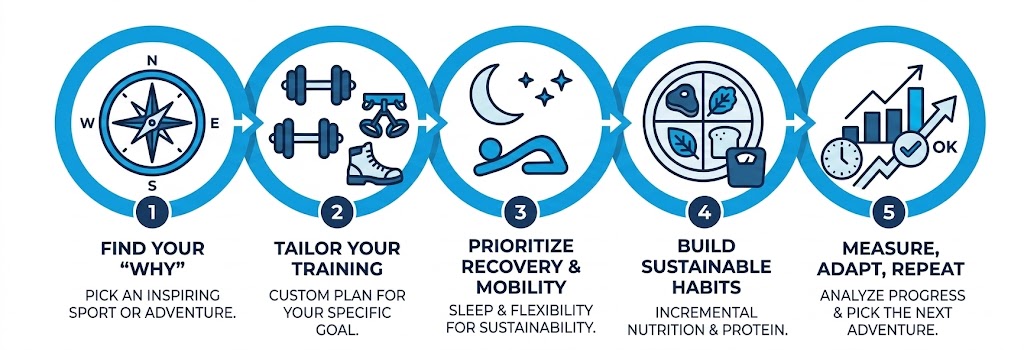
- Find Your “Why” – Pick a sport, race, or wilderness adventure that captures your imagination and makes you excited to train. Pro Tip: The people you do it with are as important as the sport itself. People give you the energy and drive to go the distance.
- Tailor Your Training – Instead of following generic routines, build a customized plan designed specifically around the physical demands of your target race or adventure.
- Prioritize Recovery & Mobility – Gains happen during rest. Without sufficient sleep, mobility work, and proper recovery, you risk injury and stall progress.
- Build Sustainable Habits – No crash diets. Gradually improve your nutrition over time. Focus on getting enough protein, cutting back on sugar and simple carbs, and making small, incremental habit changes rather than pursuing some name-brand diet.
- Measure, Adapt, and Repeat – After completing your race or adventure, analyze what worked, integrate what you learned into your routine, pick your next challenge, and restart the cycle. Always have something to train for.
How I Train in this Season of Life
There are countless fitness gurus who want you to follow their program. I’ve rarely seen a fitness guru share how THEY actually train. I thought it would be helpful and encouraging to show you, “Here is what I do,” rather than “Here is what I think YOU should do.” I hope seeing my fitness journey inspires you to pursue a new goal of your own.
I’m closing in on 60. In this season of my life, I’m not training to look better in a t-shirt. At my age, I can’t get motivated by that. I’m training to DO things. And what I want to do is climb steep elevation with weight, scrambling on Class 2, 3, 4, and 5 terrain at high altitude. I’ve got a real job, so I’ve got to be smart about where I put my limited time and energy. Here is my routine…
- Aerobic Base – I spend ~80% of my time maintaining my aerobic base. This involves staying in heart rate Zones 1 and 2 and carrying a weighted pack up steep terrain. When I can’t get outside, I use a stepmill at the gym.
- Intensity – I spend ~10% of my training doing high-intensity interval training (HIIT). This maintains a high VO2 Max, which complements my aerobic base. Once a week, I do a HIIT session on the stepmill: 5 minutes low intensity, 5 minutes max intensity for 4 rounds.
- Strength – I spend ~10% of my time on strength training, mostly bodyweight (pull-ups, push-ups, dips, single-leg squats, and ab work). If I am winning at my strength routine, it shows up in my body composition when I get a DEXA scan – typically every 6-8 weeks.
Here is a typical week for me. It varies from week to week, based on my work/family schedule, but it generally has the same elements. I try to get in a hike with a weighted vest either Thursday or Saturday. As you can see, it’s not that complicated. Think of me as the “Triumph of the Average.” For me, it’s consistency, rather than extraordinary effort, that gets extraordinary results. Nearly anyone can do this, or something like this, just tailored to their own sport.
| Monday | Tuesday | Wednesday | Thursday | Friday | Saturday | Sunday |
| HIIT Training (45 min) | Strength Training (30 min) | Early Morning Fitness Hike (2-4 hrs) | Recovery | Long Hike, Replaces my Thursday Morning (4-6 Hours) | Strength Training (30 min) |
What I Measure
I can only improve what I measure, so I take measurement seriously. Most of my data comes from a chest strap heart monitor I wear with my Garmin Fenix watch. This ensures I get accurate data. My Garmin data imports automatically into TrainingPeaks, where I can do more detailed analysis. I track ascents of mountain peaks on Peakbagger, and I track my body composition at BodyMetRX in Redlands, using a DEXA scan. Here are the stats I track annually…
Aerobic Base Stats
| Total Ascents | NEW Ascents | Elevation Gain/Loss | Backcountry Mileage | Total Fitness Hours | Training Stress (TSS) | Average Weekly TSS | |
| 2025 | 98 | 2 | 183,470 | 587 | 411 | 16871 | 324 |
| 2024 | 70 | 22 | 181,515 | 628 | 425 | 18889 | 363 |
| 2023 | 52 | 14 | 119,594 | 393 | 358 | 16475 | 317 |
| 2022 | 18 | 8 | 84,200 | 245 | 259 | 12766 | 246 |
| 2021 | 39 | 13 | 127,005 | 529 | 405 | 18616 | 358 |
| 2020 | 23 | 12 | 109,526 | 422 | |||
| 2019 | 12 | 5 | 49,930 | 125 | |||
| 2018 | 38 | 27 | 132,250 | 412 | |||
| 2017 | 17 | 6 | 67,380 | 202 | |||
| 2016 | 26 | 7 | 111,980 | 338 | |||
| 2015 | 6 | 5 | 24,280 | 67 | |||
| Total | 399 | 121 | 1,191,130 | 3948 | 1858 | 83617 |
- Total Ascents – Total number of named peaks climbed during the year.
- New Ascents – Total number of new peaks climbed during the year.
- Elevation Gain/Loss – Total elevation gain from all hiking activities during the year.
- Backcountry Mileage – Total backcountry mileage from all hiking activities.
- Fitness Hours – Total amount of recorded fitness hours captured by Garmin Connect.
- Training Stress (hrTSS) – The Heart Rate Training Stress Score in TrainingPeaks measures the physiological stress of a workout using your heart rate data. One hour spent at your lactate threshold heart rate equals 100 points. It estimates training load based on time spent in heart rate zones.
- Average Weekly TSS – Total TSS divided by 52 weeks.
Intensity Stats
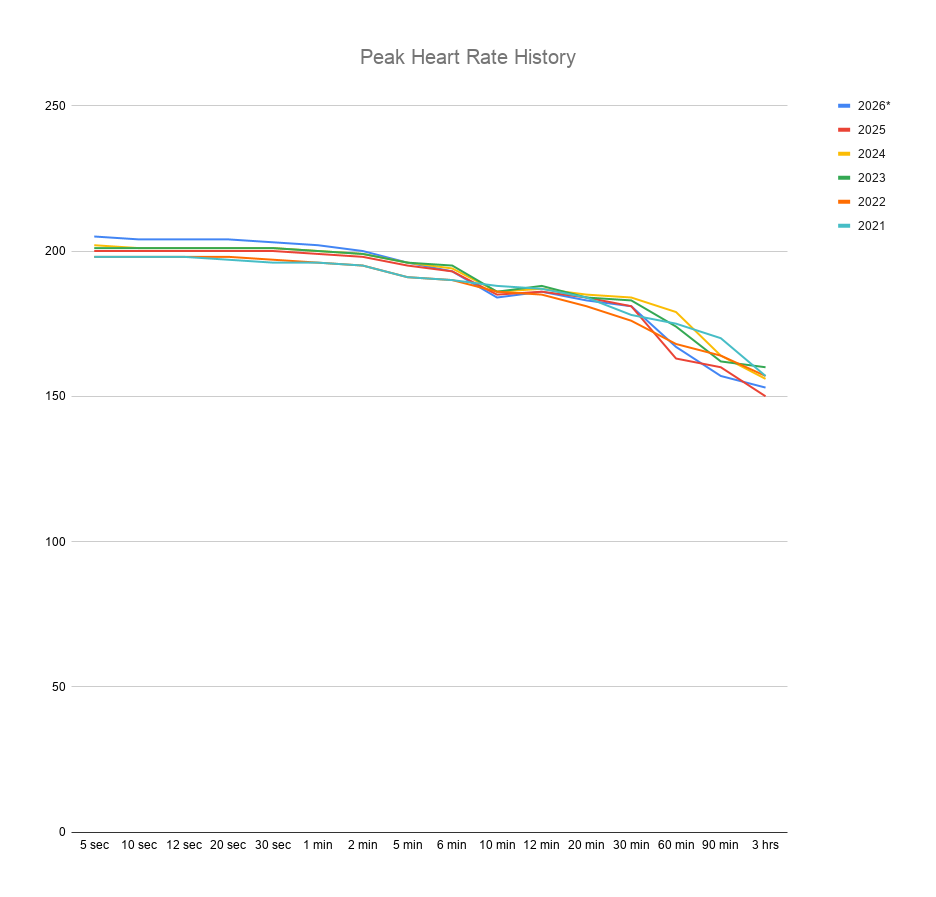
In his book Fast After 50, endurance coach Joe Friel cites the research showing that the age-related decline in performance is driven primarily by a drop in aerobic capacity (V02Max). As athletes age, many instinctively switch to low-intensity training to avoid the discomfort and injury risk of hard efforts. This is a mistake. Aging endurance athletes who only train at low intensity lose their V02Max at a rate of roughly 1% to 1.5% per year. In contrast, older athletes who consistently preserve high-intensity interval training (HIIT) lose only about 0.5% of their V02Max—cutting the rate of decline by up to two-thirds until their mid-70s. For this reason, I am very deliberate about keeping HIIT sessions as a regular part of my training routine. The chart below shows how high (beats per minute) I can hold my heart rate across time intervals.
| 2026* | 2025 | 2024 | 2023 | 2022 | 2021 | |
| 5 sec | 205 | 200 | 202 | 201 | 198 | 198 |
| 10 sec | 204 | 200 | 201 | 201 | 198 | 198 |
| 12 sec | 204 | 200 | 201 | 201 | 198 | 198 |
| 20 sec | 204 | 200 | 201 | 201 | 198 | 197 |
| 30 sec | 203 | 200 | 201 | 201 | 197 | 196 |
| 1 min | 202 | 199 | 200 | 200 | 196 | 196 |
| 2 min | 200 | 198 | 199 | 199 | 195 | 195 |
| 5 min | 196 | 195 | 196 | 196 | 191 | 191 |
| 6 min | 193 | 193 | 194 | 195 | 190 | 190 |
| 10 min | 184 | 185 | 186 | 186 | 186 | 188 |
| 12 min | 186 | 186 | 187 | 188 | 185 | 187 |
| 20 min | 183 | 184 | 185 | 184 | 181 | 184 |
| 30 min | 181 | 181 | 184 | 183 | 176 | 178 |
| 60 min | 167 | 163 | 179 | 174 | 168 | 175 |
| 90 min | 157 | 160 | 164 | 162 | 164 | 170 |
| 3 hrs | 153 | 150 | 156 | 160 | 157 | 157 |
Body Composition Stats
| 7/20/26 | 6/26/26 | 11/10/25 | 2/15/25 | 12/16/24 | 8/20/24 | 5/8/24 | 2/5/24 | 11/20/23 | 9/5/23 | 5/31/23 | 3/1/23 | 11/21/22 | 8/31/22 | 5/25/22 | 11/19/21 | |
|---|---|---|---|---|---|---|---|---|---|---|---|---|---|---|---|---|
| Weight (lbs) | 179.3 | 181.9 | 185 | 181.7 | 182.5 | 176.7 | 179.3 | 177.1 | 171.5 | 175.9 | 179.3 | 176.9 | 177.1 | 176.8 | 176.8 | 183.2 |
| Muscle Mass (lbs) | 67.3 | 70.6 | 70.7 | 66.5 | 67.2 | 68.2 | 71 | 68.5 | 66 | 67 | 68.4 | 67.5 | 68 | 69.1 | 68.2 | 70.1 |
| Fat Mass (lbs) | 34.3 | 32.8 | 36.7 | 40.6 | 38.2 | 31.3 | 28.5 | 31 | 30.8 | 32.6 | 34.2 | 31.4 | 31.4 | 28 | 33.5 | 35.4 |
| Body Fat Percentage | 19.13% | 18.03% | 19.84% | 22.34% | 20.93% | 17.71% | 15.90% | 17.50% | 17.96% | 18.53% | 19.07% | 17.75% | 17.73% | 15.84% | 18.95% | 19.32% |
My Benchmark Workouts
Effort and work capacity are two different ideas. Measuring heart rate-based data is useful, but the point of cardiovascular fitness is to do work more efficiently. In other words, it’s not about how high I can get my heart rate; it’s about how low I can keep it while doing more work than I did the time before. Doing benchmark workouts over time answers this question. To this end, I do two benchmark workouts: A loop to the summit of Mount Baldy that gains ~4,000′ in ~8 miles, and another workout near my home that I call the 5 Peaks Traverse. The traverse gains and loses ~2,000 feet in ~4.5 miles. In addition to these workouts, I also track max reps of pull-ups, push-ups, and dips as a baseline for the efficacy of my strength program.
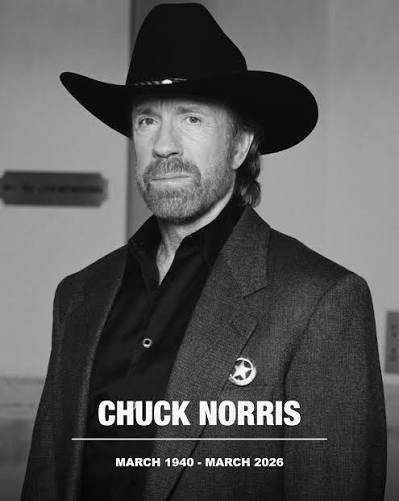
Be Like Chuck
Death is coming for us all – regardless of how fit we are. I’m not sure if I am going to live any longer by being exceptionally fit in my later years. Maybe. That assumes I don’t fall off a mountain, get cancer, or go down in a blaze of glory on the 91 Freeway. I’m not in control of this world or my life in it. What I am more sure of is that I may be able to increase my healthspan. As of this writing, Chuck Norris recently passed away in his 80s. He was still fit and training hard the day before he died. Contrast this with most Americans, who tend to get horribly sick with lifestyle diseases decades before they pass. Our later years can be some of the most impactful years of our lives, and if I can, I’d like to stay healthy enough to do the things God has planned for me to do.
| 7/20/26 | 6/26/26 | 11/10/25 | 2/15/25 | 12/16/24 | 8/20/24 | 5/8/24 | 2/5/24 | 11/20/23 | 9/5/23 | 5/31/23 | 3/1/23 | 11/21/22 | 8/31/22 | 5/25/22 | 11/19/21 | |
| Weight (lbs) | 179.3 | 181.9 | 185 | 181.7 | 182.5 | 176.7 | 179.3 | 177.1 | 171.5 | 175.9 | 179.3 | 176.9 | 177.1 | 176.8 | 176.8 | 183.2 |
| Muscle Mass (lbs) | 67.3 | 70.6 | 70.7 | 66.5 | 67.2 | 68.2 | 71 | 68.5 | 66 | 67 | 68.4 | 67.5 | 68 | 69.1 | 68.2 | 70.1 |
| Fat Mass (lbs) | 34.3 | 32.8 | 36.7 | 40.6 | 38.2 | 31.3 | 28.5 | 31 | 30.8 | 32.6 | 34.2 | 31.4 | 31.4 | 28 | 33.5 | 35.4 |
| Body Fat Percentage | 19.13% | 18.03% | 19.84% | 22.34% | 20.93% | 17.71% | 15.90% | 17.50% | 17.96% | 18.53% | 19.07% | 17.75% | 17.73% | 15.84% | 18.95% | 19.32% |